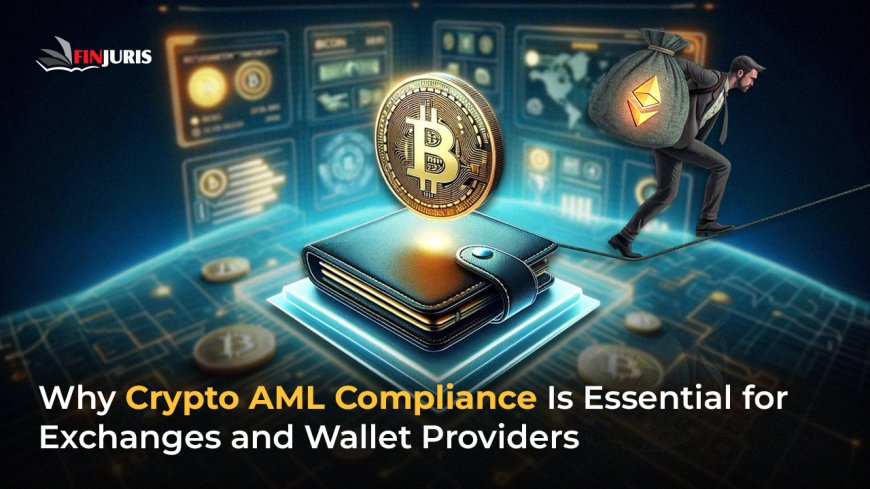
Why Crypto AML Compliance Is Essential for Exchanges and Wallet Providers
Discover why Crypto AML compliance is vital for exchanges and wallet providers to protect your business, build trust, and stay ahead of regulatory changes.

If you're building in crypto, you already know this industry doesn’t operate on yesterday’s logic. You’re working with a financial system that evolves faster than the world’s regulators can write new rules. But while the tech moves at light speed, the one thing that still slows companies down — sometimes to a full stop — is compliance.
For years, crypto AML compliance was treated like a legal obligation which is something everyone had to deal with eventually, but nobody wanted to think about while they were scaling. That mindset has changed. Today, AML is no longer a back-office formality, it’s a business survival mechanism and a strategic foundation for exchanges and wallet providers.
Because in a market where regulators are increasing oversight, banks are de-risking aggressively, and enforcement actions are getting louder. It determines whether you can bank, trade, expand, raise capital, partner, or even stay operational.
And if you’re an exchange, OTC desk, custodial wallet provider, or even a Web3 app touching user funds, you need to consider that what you do with AML will define your future.
This is why understanding why crypto AML matters is far more important than simply attempting to comply with the bare minimum. Finjuris in this article will help you understand what is the real reasons behind crypto compliance and AML.
1. AML Facilitate Your Access to Banking
In crypto, banking is the lifeline of your business and without it, your fiat rails collapse. Your settlements freeze. Your operations get stuck. And yet, most exchanges know the pain of dealing with banks that treat anything “crypto” like a radioactive substance.
When institutions review your application, they’re not just evaluating your balance sheet or your product; they’re evaluating your risk. And the single biggest indicator they look at is your AML framework.
A robust crypto AML program could differentiate between gaining a reliable commercial account, or getting rejected or passed up for an account multiple times, having clear payment permitting pathways, or having to manage constant flags and delays, and being treated like a valued partner and not an impossible risk.
Banks understand crypto better now than they did years ago, but they’re also under more scrutiny than ever. A crypto client with poor AML is a regulatory liability. A crypto client with a robust AML system is a strategic partner.
If you want uninterrupted access to fiat channels, card processing, stable liquidity pipelines, and institutional partnerships, AML is the price of admission.
2. AML Shields You From Enforcement Actions That Can Destroy a Business
The last few years have made one thing clear that regulators are no longer watching quietly they’re acting and forcing hefty fines.
We’ve watched multi-billion-dollar exchanges collapse overnight due to AML failures. We’ve seen CEOs face criminal charges because their companies didn’t have proper controls. And we’ve seen global regulators coordinate cross-border enforcement at a speed nobody thought was possible.
The pattern is simple:
Weak or superficial AML → fines → lawsuits → shutdowns → personal liability.
If you see and check, you will realize that this evolvement doesn’t happen in one single jurisdiction, and not just in the United States, you can find it happened in the UAE, Singapore, Hong Kong, South Korea, Europe, and even smaller jurisdictions are tightening frameworks. Global regulators share more data than ever. A failure in one country becomes a problem in five others.
This is the cost of ignoring AML:
-
Frozen assets
-
License suspensions
-
Blacklisting from banking partners
-
Reputational collapse
-
Investor withdrawal
-
Criminal exposure for executives
But here’s the surprising part:
Most enforcement actions don’t happen because companies intend to launder money. They happen because founders underestimate what a proper AML system actually requires.
-
A vague policy and an outsourced KYC provider is not AML.
-
A generic risk assessment copied from another company is not AML.
-
Running sanctions screening alone is not AML.
Crypto AML requires structure, monitoring, governance, escalation pathways, and jurisdiction-specific compliance. Without those elements, a company becomes exposed even if its intentions are good.
3. AML Builds the Credibility You Need With Investors and Institutional Partners
Based on the experience we have in Finjuris we have seen many crypto exchanges and wallet providers often spend months improving their tech stack while overlooking a simple truth, the institutions invest in companies they can trust and that is the key for a sustainable growth.
And trust is built on compliance.
Institutional investors — including VCs, family offices, and private equity funds — now conduct extensive compliance due diligence before touching any crypto business. But before you enter any new partnership, we have listed for you a few questions so you evaluate how ready your business is:
-
Do you have a risk-based AML program aligned with FATF guidelines?
-
Do you monitor wallet behavior and chain analytics?
-
Do you file suspicious activity reports?
-
Do you have a dedicated MLRO?
-
Do you conduct ongoing CDD and EDD?
-
Are minors, PEPs, and high-risk jurisdictions properly managed?
If the answer to these questions is unclear or incomplete, the investment dies — no matter how impressive your product is.
Because investors have learned the hard way that AML gaps turn into regulatory explosions. And regulatory explosions destroy valuations, reputations, and exits.
The same applies to strategic partnerships with:
-
Payment processors
-
Banking institutions
-
Liquidity providers
-
Compliance vendors
-
Global exchanges
-
Enterprise clients
Your AML is the legal requirement and the credibility signal for your business. It tells the world:
“We take risk seriously. We operate responsibly. We are here to stay.”
In a sector where trust is scarce, this is a massive advantage.
4. AML Creates Safer Platforms for Users
Crypto has always carried a reputational challenge. Every industry leader is trying to build something that can stand next to traditional finance, not remain trapped in the shadows of early-stage crypto scandals.
Strong AML is a step toward legitimacy. It filters out bad actors and attracts high-quality customers, institutions, and service providers.
A clean platform is a valuable platform.
Good AML reduces:
-
Fraud
-
Account takeovers
-
Wash trading
-
Money mule activity
-
Market manipulation
-
NFT fraud
-
Ransomware payouts
-
Scams flowing through your platform
When you stop criminals from entering your system, you protect the honest users who keep your business alive. And users notice. Exchanges with strong compliance frameworks gain a reputation for security, reliability, and long-term stability.
That translates directly into:
-
Higher user retention
-
Safer trading environments
-
Reduced operational losses
-
Lower chargeback rates
-
Greater institutional trust
For all the customer quality matters and AML helps you cultivate the right audience — the kind that builds your brand instead of destroying it.
5. AML Future-Proofs Your Business Against Changing Regulations
What is optional today will be mandatory tomorrow. And the companies that survive regulatory tightening are not the ones racing to catch up; they’re the ones preparing early.
Regulators worldwide are converging toward a shared set of standards driven by the FATF Travel Rule, risk-based AML frameworks, and stricter VASP licensing.
Whether you operate in the UAE, the EU, Singapore, Hong Kong, or anywhere else, these changes are coming for you:
-
Enhanced blockchain analytics expectations
-
Mandatory Travel Rule compliance
-
Stricter onboarding requirements
-
Increased scrutiny for DeFi interfaces
-
Proactive transaction monitoring
-
Real-time risk scoring
-
Licensing tied directly to AML performance
If your company is not prepared, it will be forced into expensive, emergency compliance reactions or forced out of the market altogether.
Early AML adoption gives you a buffer. It allows you to adapt smoothly instead of being blindsided. It also ensures that your business model remains viable even as global rules tighten.
In crypto, you can’t afford to play catch-up with regulation. You have to stay ahead of it.
6. AML Is the Foundation for Scaling Globally
Many exchanges and wallet providers launch with excitement and momentum, but expansion becomes impossible because they lack the compliance infrastructure regulators require.
The moment you attempt to scale, you hit the AML bottleneck:
-
Want a license in Dubai? AML will determine approval.
-
Want to enter the EU? AML must align with MiCA.
-
Want to operate in Singapore? The MAS will scrutinize your AML in detail.
-
Want to enter the US? AML becomes existential.
Global expansion is actually a compliance challenge disguised as a growth challenge.
If your AML is weak, your market access shrinks.
If your AML is strong, your market access expands.
The companies that scale across continents aren’t necessarily the ones with the best tech. They’re the ones with compliance frameworks built to global standards.
7. AML Protects Founders Personally
What many founders don’t realize is that AML failures create personal liability.
Regulators can — and do — target:
-
CEOs
-
Founders
-
CTOs
-
MLROs
-
Board members
Weak AML exposes leadership personally, not just the company.
You can build a brilliant exchange and still face criminal penalties if:
-
Proper reporting wasn’t done
-
High-risk users weren’t escalated
-
Sanctions screening failed
-
Funds tied to illicit activity flowed through your platform
AML protects your leadership team from being held accountable for failures they never intended. A compliant business is also a protected business legally and personally.
8. AML Is an Investment, Not an Expense
Many early-stage companies treat AML like a cost they want to minimize. But experienced founders know the truth:
AML is an asset that generates ROI in stability, trust, scalability, and longevity.
Crypto AML is not bureaucracy. It’s infrastructure. It’s the legal, operational, and reputational foundation that determines whether an exchange or wallet provider becomes a global leader or a cautionary tale.
A robust crypto AML framework is the most strategic investment you can make in the long-term survival and success of your platform.
Because in crypto, there are two kinds of companies:
-
Those that treat AML like paperwork.
-
And those that treat AML like infrastructure.
At Finjuris, we always advise our clients to stay ahead of regulators by building robust compliance infrastructure from the very start, training their teams thoroughly, and protecting the company from potentially hefty fines down the line.
What's Your Reaction?